Field and modes
PokeSurvivor runs, rifts, weather, and co-op
A normal PokeSurvivor run is one continuous field, not a stage select. The map changes biome, weather, and pressure while you stay in the same run. A rare rift is the mode that actually moves you: step in and you fight a legendary in one of 18 type arenas, then return to the field whether you win or fall.
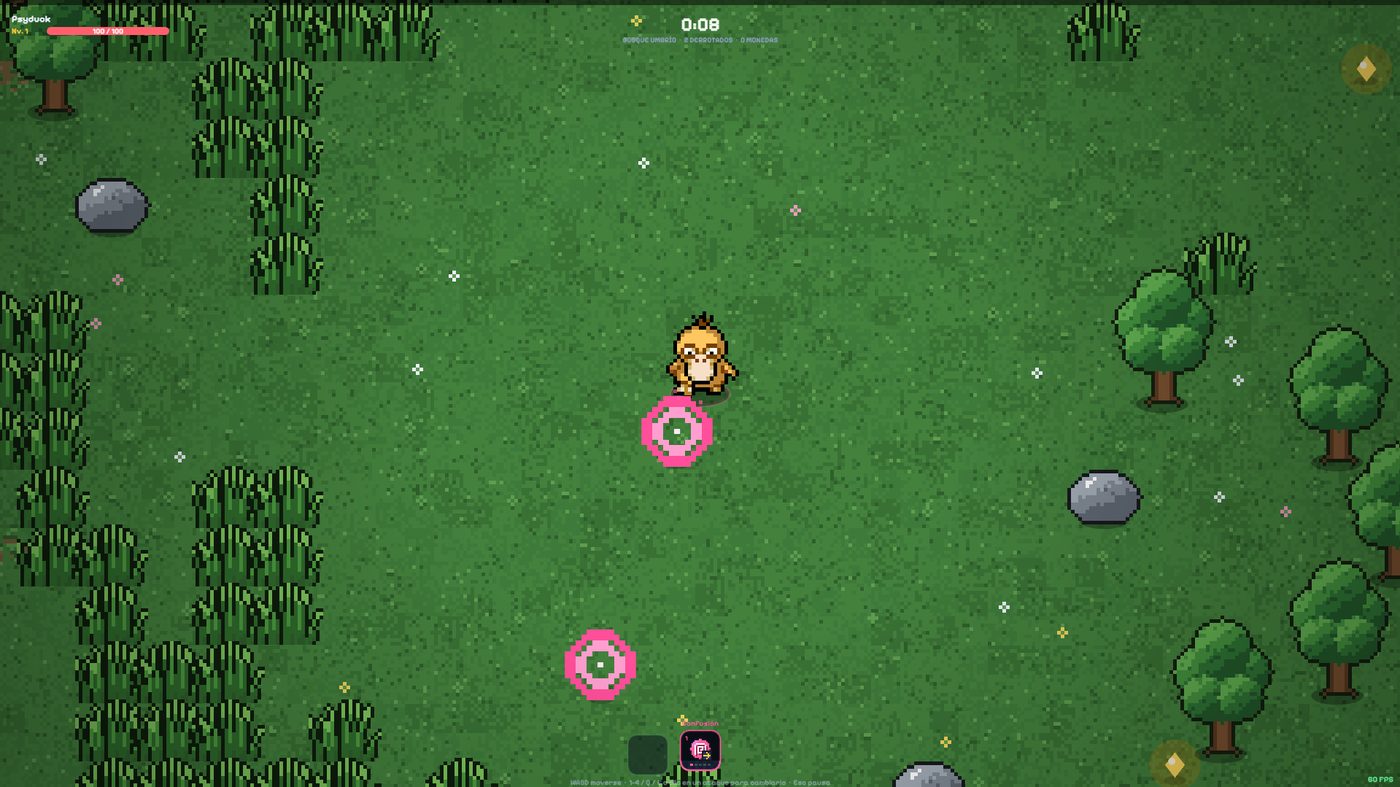
Three biomes, one run
The client’s English strings name three field biomes: Shady Forest, Crystal Cave, and Ash Volcano. The design document says they rotate about every four minutes, with a short fade between palettes, and that each has its own music. The public English guide does not describe that rotation. The screenshot above only confirms Shady Forest at the start of one published run.
Terrain is described in the repository README and the design document, and some of it is visible in the screenshots: tall grass, rocks, and trees. The README says rocks, chests, and tall grass can be broken, walls and trees block enemy shots, water slows, and lava burns. The design document adds numbers the English guide does not: water at about ×0.6 speed for the player, lava that burns whoever stands in it, and type-based immunities such as Fire ignoring lava. Those numbers are design-document figures.
The same sources describe objects you walk up to:
- An altar grants a short power. English strings name Fury, Haste, and a pull effect (“you pull everything from afar”), with lines for double damage, +45% speed, and −40% cooldown. The design document says the altar stays active for 25 seconds.
- A spring heals while you stand on it, then dries up and refills on its own. The English string says exactly that. The design document estimates the refill at about 45 seconds.
- A locked chest asks you to stay beside it. The design document says about 3.5 seconds, and lists coins, tickets, and enough experience to level.
- Traps are described as poison, sticky, or explosive, and the design document says they also hit enemies.
The English guide page aimed at players does not list altar durations or chest timers. If the live client and the design document ever disagree, the design document is the one that printed the seconds.
Bosses, swarms, and personalities
The English guide says some enemies heal, shield their allies, summon help, explode, or fire beams that are marked on the ground before they land. The design document gives those roles more names (ray, zones, fan, and jumper) and example species, and it places five non-legendary bosses at about 3, 6, 9, 12, and 15 minutes. It also says legendaries are reserved for rifts, and that a boss can drop a ×10 ticket. The public guide agrees that bosses and rift legendaries sometimes drop ×10 tickets. It does not print the minute marks, so those minutes stay attributed to the design document.
A later design-log entry (10 October 2026) changes several pressure numbers, including how many enemies can be on screen at once. Because that log contradicts earlier caps in the same file, this guide does not state a current enemy cap. No public English page prints one.
That same dated note describes mid-run events the English guide also does not mention: a typed horde, a “golden hour” with double experience and coins, a lost partner you escort, and treasure creatures (Meowth, or Gholdengo) that flee. Treat those as design-log events until a public guide page describes them.
The 18 rift arenas
The legendaries page says a rift opens rarely. Enter it and you face a legendary in an arena of its type, with its own terrain and weather. A win pays a ×10 gacha ticket. A loss sends you back to the map with no reward. In a group, everyone goes in. Dual-type legendaries pick one of their types at random for the arena. The page says the encounter list has 87 legendaries. This guide does not copy that list.
Arena names below are the English names on that page. Terrain notes in the last column are from the design document, which pairs each arena with a hazard and, often, a weather type.
| Type | Arena | Design-document terrain |
|---|---|---|
| Normal | Eternal Meadow | Columns |
| Fire | Igneous Volcano | Lava rivers that burn, harsh sunlight |
| Water | Sea Grotto | Pools that slow, rain |
| Grass | Emerald Jungle | Bog that slows, trees |
| Electric | Volt Plant | Electrified pools, rain |
| Ice | Eternal Glacier | Ice plates that slide, snow |
| Fighting | Ancient Dojo | Many columns |
| Poison | Toxic Swamp | Poison pools |
| Ground | Red Desert | Sinking sand, sandstorm |
| Flying | Sky Peak | Cloud trees |
| Psychic | Mind Temple | Pink crystals and columns |
| Bug | Hive Forest | Bog and tall grass |
| Rock | Ancient Quarry | Columns, rocks, sandstorm |
| Ghost | Gloomy Graveyard | Dead trees, fog |
| Dragon | Dragon Sanctuary | Flames that burn |
| Dark | Dark Alley | Columns |
| Steel | Steel Fortress | Many columns |
| Fairy | Enchanted Forest | Pink trees and springs |
The public page’s own terrain line is shorter: lava burns, ice is slippery, and water slows you. The design document adds that the legendary collides with the arena and cannot leave the circle, and that falling in a rift returns you without the prize. It also describes a time limit and a partial heal on failure. Those details are not on the public legendaries page, so they stay marked as design-document text.
Weather and the softened type chart
The English type page says the familiar chart is softened because you have one active move and cannot switch partners. Super effective deals ×1.6, not very effective ×0.6, and an immunity becomes ×0.3. Two types multiply, with a cap of ×2.4. It works in both directions: your move against them, and theirs against you. A worked example from that chart: Water into Fire is ×1.6, Electric into Ground is ×0.3, and a double resistance can stack until the cap.
Weather, in the same page and in the client’s English strings:
- Rain: Water is boosted and Fire is weakened.
- Harsh sunlight: Fire is boosted and Water is weakened.
- Sandstorm: Rock, Ground, and Steel are boosted; the rest suffer.
- Snowfall: Ice is boosted; the rest suffer and slow down.
- Fog: Ghost, Fairy, and Psychic are boosted.
The design document gives extra numbers (for example ×1.5 and ×0.5 on sun and rain, plus chip damage in sand and snow). The public type page does not print those multipliers, so the lines above are the description the English client actually shows.
Co-op, missions, and the ranking
Online co-op is up to four players. The FAQ says you add friends by nickname, invite them to your room, and start together. Experience is shared, and a fallen teammate can be revived by standing next to them. The design document is more specific: about three seconds beside them, and they get up at half health. It also says the host runs the enemies and the clock, each player runs their own partner, and the pause menu does not stop a group run. The pause section in the page file agrees that a group match keeps going while that menu is open. If the host leaves, the design document says the run ends for everyone.
The FAQ lists daily and weekly missions, 127 achievements with medals and titles, a public profile, and leaderboards. The ranking heading in the page file is time survived. Solo and group tabs, and the day-to-all-time periods, are described in the design document, along with a friends filter and a historical filter by partner. Those filters are not spelled out on the English FAQ.
Co-op, cloud saves, and the ranking need the online game. The itch download is solo and keeps its save in that browser.
The eight phases belong to a different fan project
Searches for “PokeSurvivor stages” sometimes land on giovanneluna/poke-survivors. That repository’s README describes eight phases, each with more than 20 waves, unique bosses, and rising difficulty. The enemy data folder contains eight phase files, named phase1 through phase4 and coast-sp1 through coast-sp4. Its playable starters, in that README, are Charmander, Squirtle, and Bulbasaur, and it lists 77 attacks. You run it locally with npm, at the port its README names, or as a Tauri desktop build.
That is not the browser game at pokesurvivor.com, which does not publish an eight-stage select. Using those phase files as a walkthrough of the live run will describe bosses and waves the live field does not use. This page does not copy stats out of those phase files, because they are a different game.